
Elevated Storage Reservoir Management System with Powered Devices
Introduction
Elevated Storage Reservoirs (ESRs) form the backbone of most municipal and industrial water distribution systems. Maintaining consistent water levels and flow balance is essential for ensuring pressure stability and uninterrupted supply across the network.
Traditional ESR setups often depend on manually recorded readings that lack central connectivity. In many cases, dependence on grid power or limited communication infrastructure prevents continuous data availability, affecting system efficiency and timely
maintenance response.
SBEM’s ESR Management System with powered devices delivers a dependable and flexible field measurement setup, utilizing level transmitter, electromagnetic flow meters (with/without in-built pressure transmitter), pressure transmitters, an optional central power system that operates through solar energy. For IoT connectivity, an optional RTU (Remote Terminal Unit) with RS485 communication input along with Analog & Digital input to monitor data on the IoT-based web app (SenSphere).
This integrated powered devices solution ensures uninterrupted monitoring of ESR water levels, flow, and pressure, helping utilities achieve precise measurement visibility, reduced manual intervention, and improved network performance.
General Arrangement
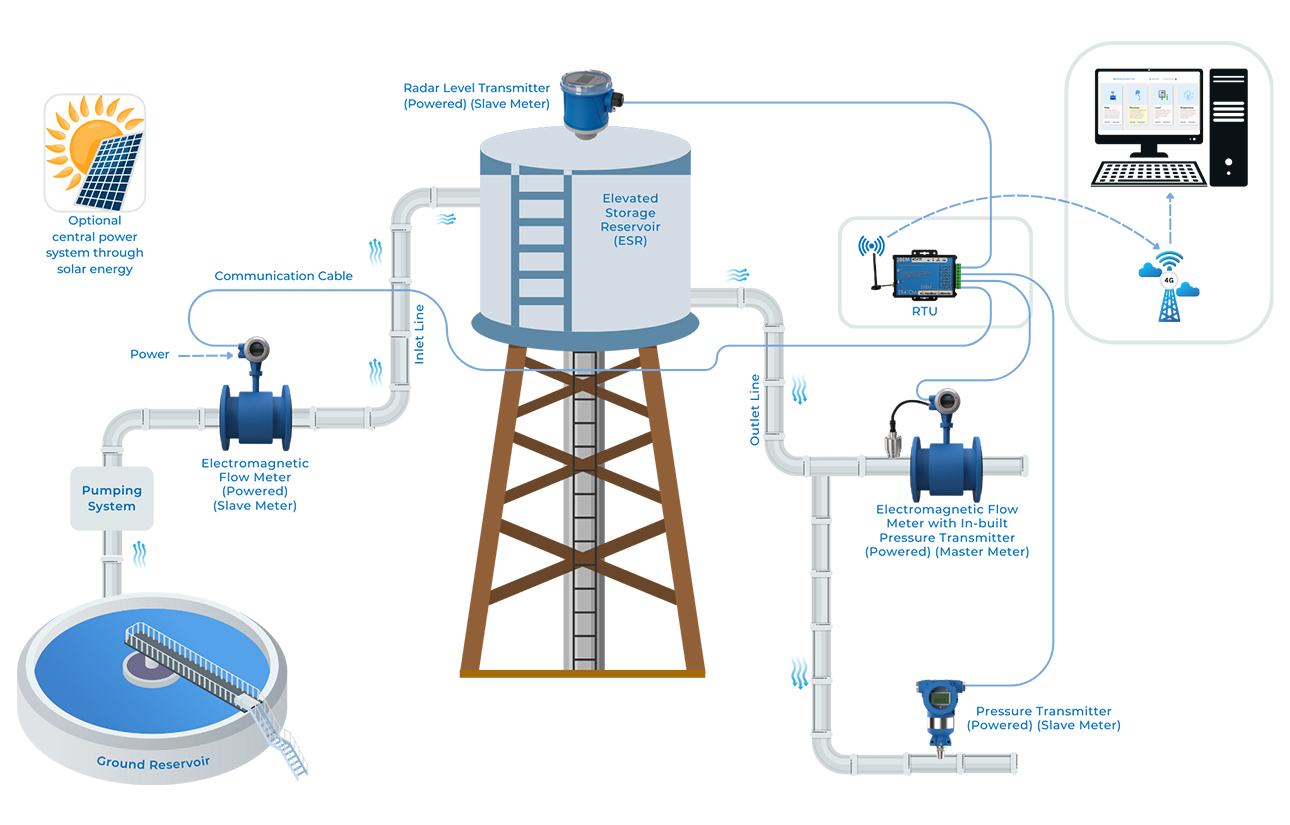
Key Components
Radar Level Transmitter:
Provides accurate, contactless level measurement of the Elevated Storage Reservoir using 80 GHz radar technology.
Electromagnetic Flow Meter (with/without In-Built Pressure Transmitter):
Measures inlet and outlet water flow with high precision. The optional built-in pressure transmitter allows simultaneous monitoring of flow and pressure from a single compact device.
Pressure Transmitter:
Monitors pressure within the ESR distribution system to maintain stable operation that may affect system efficiency.
An Optional Central Power System (Solar):
Ensures continuous power supply to all instruments, operating via an optional solar energy setup for sustainable operation in energy-variable environments.
Telemetry Communication System:
Transfers aggregated field data (level, flow, and pressure) to centralized monitoring systems or cloud-based dashboards, supporting seamless integration into digital water infrastructure.
IoT Connectivity (Optional RTU with RS485 Communication):
For IoT connectivity, an optional RTU (Remote Terminal Unit) with RS485 communication input along with Analog & Digital input enables seamless data monitoring and configuring on the IoT-based web app (SenSphere).
Features & Benefits
Continuous Monitoring:
Real-time data monitoring with an optional RTU (Remote Terminal Unit) with RS485 communication input along with Analog & Digital input
Energy-Efficient and Cost-Saving Option:
Solar-ready configuration reduces dependency on grid power, minimizing long-term operational costs.
Integrated Multi-Parameter Monitoring:
Accurately measures level, flow, and pressure, ensuring precise visibility of ESR operations and water distribution efficiency.
Telemetry-Based Communication:
Supports data exchange with monitoring systems or cloud-based dashboards through RTU with RS485 communication, enables monitoring and configuration.
Data Monitoring:
Enables data acquisition and visualization through telemetry links, optimizing operational monitoring and performance tracking.
Applications
Industrial and Process Plant Water Storage Systems
Municipal Water Supply and Distribution Networks
Smart Infrastructure and Utility Management Projects
Power Plants and Manufacturing Facilities
Housing Societies and Commercial Building Water Systems
Institutional and Government Inf rastructure Projects
Large Industrial Estates and Special Economic Zones (SEZs)
Integrated Water Resource Management (IWRM) Systems
Outcome
- SBEM’s ESR Management System with powered devices ensure continuous and reliable operation through electric or an optional solar energy, offers monitoring solution for industrial and municipal inf rastructures.
- With high-performance transmitters, optional RTU integration (IoT connectivity), and telemetry connectivity, it provides accurate insights into system performance and resource efficiency.
- The solution enhances operational visibility, supports IoT-based integration, and contributes to long-term sustainability and optimized water distribution efficiency across large-scale and powered installations.