
Submarine: Tank Gauging System Solution
Automated Fluid Level Monitoring & Control Using SBEM Model 171 TGS
Challenge: Accurate Flow Monitoring in Submarine Systems
Submarines operate with multiple interconnected tanks carrying fuel, ballast water, and cargo oils, where maintaining accurate level control is crucial for buoyancy, stability, and operational safety.
Traditional manual or analog measurement methods are prone to inaccuracies, delayed response, and potential overfill or dry-run risks, especially in enclosed and pressurized environments. The challenge lies in developing a reliable, explosion-safe, and fully automated system capable of providing real-time remote monitoring, alarm annunciation, and data communication with the ship’s Integrated Platform Management System (IPMS).
SBEM’s Engineering Solution
SBEM developed the 171 Tank Gauging System (171 TGS), a marine-grade, distributed monitoring system that provides continuous level measurement, indication, and alarm protection across all submarine tanks.
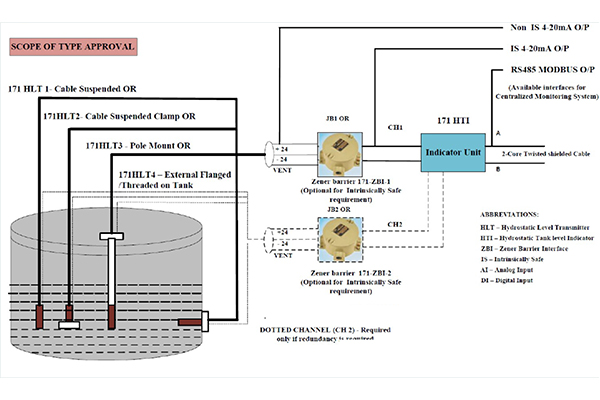
The system integrates four major components:
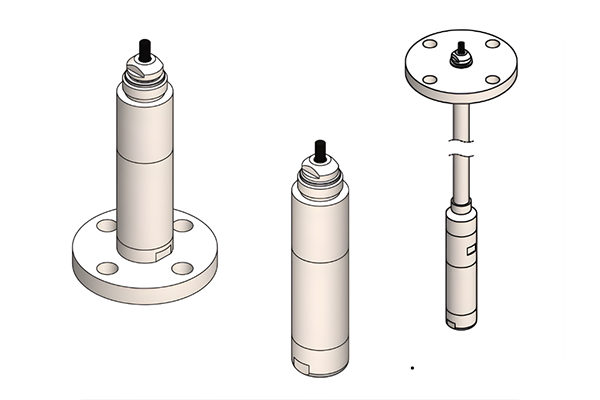
171 HLT: Hydrostatic Level Transmitter
Measures the liquid level using hydrostatic pressure.
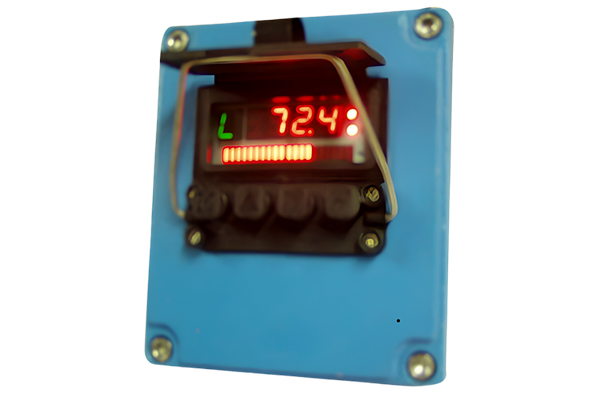
171 HTI: Hydrostatic Tank Level Indicator
Provides local indication and control via a digital display.
171 ZBI: Zener Diode Interface Barrier
Ensures intrinsic safety in hazardous zones.
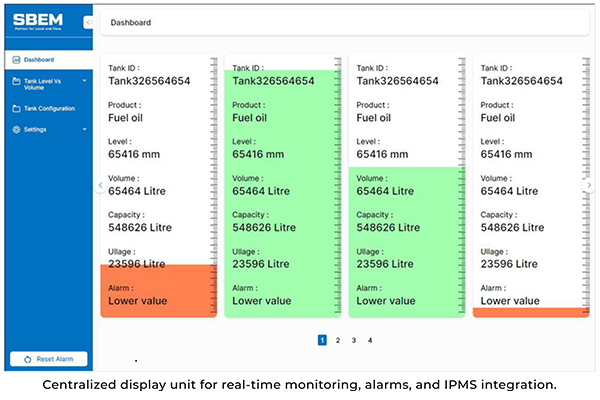
Marine Panel PC / HMI
Centralized display unit for real-time monitoring, alarms, and IPMS integration.
SBEM’s modular design allows flexible configuration for fuel, ballast, and cargo oil tanks while minimizing cable runs and simplifying onboard installation.
Working Principle
- The 171 HLT transmitter operates on the hydrostatic pressure principle.
- A pressure-sensitive diaphragm measures the force exerted by the liquid column above the sensor tip. This pressure is converted into an electrical signal proportional to the tank level and transmitted as a 4–20 mA analog output.
- The 171 HTI receives this signal, processes it through a microcontroller-based digital system, and displays the level, volume, or mass data.
- The 171 ZBI barrier ensures intrinsic safety by limiting the voltage and current in the hazardous area circuit.
- All measured parameters are displayed locally and transmitted to a Marine Panel PC / HMI, where operators can view real-time tank data, acknowledge alarms, and control system parameters via a SCADA-based interface integrated with the submarine’s IPMS.
Why SBEM’s Solution Stands Out
Marine-Approved Design:
Certified by the Indian Register of Shipping (IRS) for naval use.
Explosion-Safe Protection:
Intrinsically Safe (Ex ia) and Flameproof (Ex d) variants for hazardous zones.
High Accuracy:
Total system accuracy up to ±0.3% of full scale ensures precise readings.
Dual Redundant Channels:
Two transmitters per tank provide automatic backup and health checks
Digital Intelligence:
5-digit LED display, alarm acknowledgment, and Modbus RTU communication.
Programmable Interface:
Alarm limits, calibration, density, and tank strapping can be set on-site.
Environmental Durability:
IP68-rated transmitters for continuous immersion and IP67-rated indicators.
Cost-Effective Distributed Architecture:
Reduces cabling, improves reliability, and simplifies maintenance.
Applications
Fuel Level Monitoring
Continuous measurement in diesel, HFO, and aviation fuel tanks.
Ballast Tank Level Control
Precision tracking for submarine buoyancy balance.
Cargo Oil Level Management
Safe loading/unloading with overfill protection.
Draft Measurement
Hydrostatic pressure-based draught calculation for vessel stability.
Integrated IPMS Interface
Real-time level data to submarine control systems.
Overfill Alarm & Protection
Automatic alarm at pre-set levels.
Leak and Volume Tracking
Detection of abnormal level drops or volume loss.
Marine Vessel Retrofitting
Suitable for submarines, tankers, and naval support ships.
Outcome: Reliable Defence-Grade Performance
SBEM’s 171 Tank Gauging System delivers high reliability, precision, and safety for submarine and naval applications.
The system’s intrinsic safety certification, marine approval, and redundant sensor architecture ensure uninterrupted monitoring under challenging underwater conditions.
Its integration with the IPMS system enables seamless vessel management and contributes to operational readiness, safety, and mission reliability, a true testament to SBEM’s commitment to defence-grade instrumentation excellence.