
Submarine: Temperature Monitoring Solution
Precision Temperature Transmitter along with a Temperature Sensing Element (RTD) Based Temperature Monitoring System for Pneumo-Hydraulic Control
Challenge: Accurate Flow Monitoring in Submarine Systems
In the submarines, maintaining accurate temperature control across pneumo-hydraulic systems (SECS: Service Equipment Control System) is vital for operational safety and system performance.
The challenge was to continuously monitor both internal and outboard temperatures within the submarine’s pressure hull, in locations exposed to vibration, humidity, pressure variation, and saline conditions, without signal drift or failure.
Traditional temperature sensors struggled to perform under extreme pressure and thermal fluctuations. The Naval required a rugged, highly accurate, and remotely monitorable temperature measurement system capable of reliable data transmission to the submarine’s SECS control architecture.
SBEM’s Engineering Solution
SBEM designed and supplied the Temperature Monitoring Device (TMS Series), a dual-part system engineered specifically for marine and submarine applications, ensuring accurate temperature sensing, health monitoring, and reliable signal transmission under extreme operational environments.
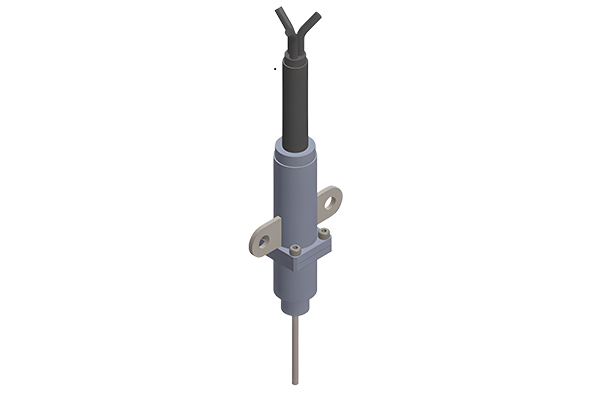
- Primary Converter (TMS-TS Series):
- Models: 200TMS-TS-2m, 200TMS-TS-7m, 200TMS-TS-25m
- These units consist of Platinum RTD sensors (PT-100, Class A) embedded within stainless-steel probes, designed to measure temperatures inside and outside the submarine containers. The sensors are bolted to welded bushes on containers or hull frames for secure and vibration-proof installation.
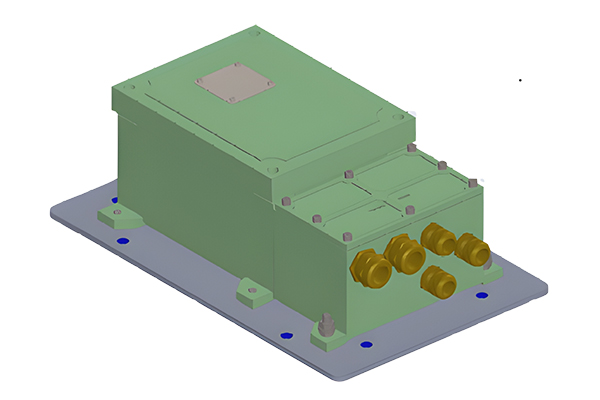
- Secondary Converter (TMS-TT Series):
- Models: 200TMS-TT-2-1, 200TMS-TT-2-2, 200TMS-TT-4
- The secondary converter transforms the RTD’s resistance signal into a standardized DC output (0–10 V) for the SECS system. It features health-check circuitry, zero adjustment, and linearization circuits to maintain long-term stability and precision.

Working Principle
- The RTD sensor (PT-100) utilizes platinum’s property of changing resistance proportionally
with temperature. - As temperature rises, resistance increases, which is detected by the bridge amplifier circuit within the TMS-TS unit.
- This resistance change is converted into a proportional DC voltage signal.
- The secondary converter (TMS-TT) receives this signal, applies feedback, linearization, and zero correction, and outputs a standard 0–10 V signal to the SECS control panel.
- The system includes a health-check feature, where applying 27 ± 2.7 VDC simulates a test signal, confirming the transmitter’s functionality through a steady ±5 V output response.
Why SBEM’s Solution Stands Out
Naval-Grade Accuracy:
Built with Class A PT-100 sensors for precise thermal measurement.
Marine-Rated Durability:
Tested to operate under 30 kg/cm² pressure, resistant to salinity and vibration.
Health Check Functionality:
Onboard 27 VDC verification ensures operational readiness.
Dual-Converter Architecture:
Electrical isolation between sensing and control circuits enhances reliability.
Linearized Output Signal:
Provides standardized 0-10 VDC output compatible with SECS.
Compact & Vibration-Proof Design:
Secure bolted mounting to container bushes.
Ingress Protection:
IP55-rated aluminium alloy enclosure ensures protection f rom moisture and corrosion.
Compliant to Naval Standards:
Designed as per JSS 55555, IEC 60751, IEC 60770, and MIL 461E.
Applications
Submarine Pneumo-Hydraulic (SECS) System Temperature Monitoring
Outboard & Inboard Container Temperature Control
Marine Tank and Equipment Thermal Regulation
Defence and Naval Automation Systems
Critical Control Panel Feedback in Pressure Hull
Outcome: Reliable Defence-Grade Performance
- SBEM’s Temperature Monitoring Device (TMS Series) ensures continuous, accurate, and fail-safe temperature feedback to the submarine control systems.
- The integrated RTD-Transmitter design, coupled with marine-grade durability and selfdiagnostic capability, enhances safety, automation, and long-term performance in underwater environments, reaffirming SBEM’s commitment to “Engineering Precision for Mission-Critical Defence Applications.”