
Submarine: Phase Capacitance Level Detection Solution
Continuous Liquid Level Monitoring in Pressurized Submarine Systems Using SBEM PCLS Sensors
Challenge: Accurate Flow Monitoring in Submarine Systems
In submarine environments, precise level monitoring of critical fluids such as f resh water, salt water, or sea water is essential for operational control, system stability, and crew safety.
The challenge arises f rom high-pressure conditions, irregular tank geometries, and variable dielectric media that make conventional level measurement unreliable.
Defence applications demand a robust, redundant, and maintenance-f ree system capable of performing accurately under pressurized and confined submarine conditions with minimal drift and consistent calibration integrity.
SBEM’s Engineering Solution
SBEM designed and developed the Phase Capacitance Type Level Sensor (PCLS), a marinegrade, defence-qualified continuous level measurement system engineered for submarine applications.
The system comprises two key components:
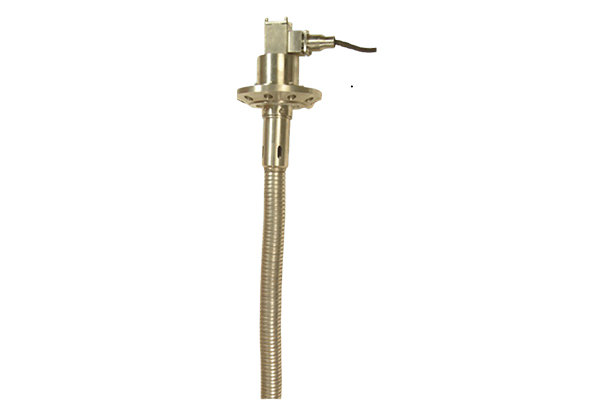
- Phase Capacitance Level Sensor (Primary Converter) PCLS-PC
- A flexible, double-loop electrode with a protective metallic hose that senses capacitance change due to liquid level variation.
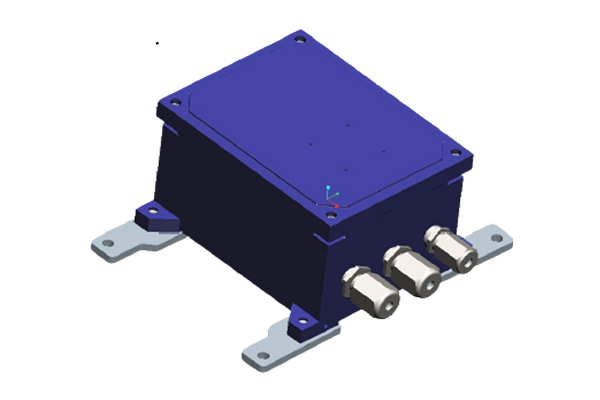
- Buffer Amplifier & Power Unit (Secondary Converter) PCLS-SC
- A ruggedized amplifier and signal conditioning unit that converts capacitance variation into a standardized 0-10 V DC output for control system interfacing.
- It includes redundant electronic circuitry to ensure uninterrupted operation.
SBEM’s solution provides continuous, real-time level indication with high accuracy and longterm stability, optimized for submarine systems operating up to 45 kg/cm² pressure.
Working Principle
- The PCLS system operates based on the capacitance measurement principle.
- A capacitor is formed between the electrode (sensor) and the metallic hose (ground) with the liquid medium acting as the dielectric.
- As the liquid level changes, the dielectric constant between these plates varies, resulting in a proportional change in capacitance.
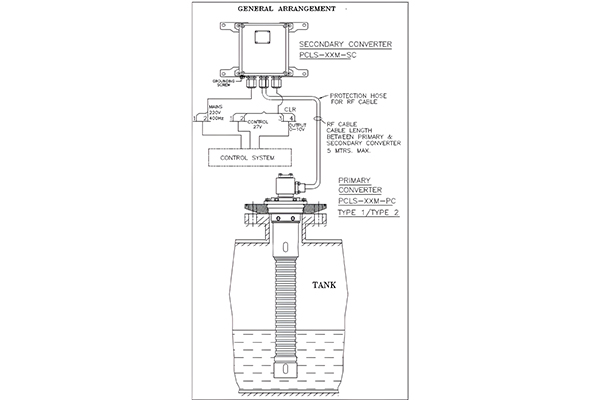
- This capacitance is sensed by the primary converter (PCLS-PC) and transmitted via an RF cable (RG59) to the secondary converter (PCLS-SC).
- The secondary unit, powered by 220V, 400Hz AC, converts this change into a 0–10 V DC analog signal, linear to the tank’s level.
- A microcontroller-based amplifier processes the signal, and a health check function (+27VDC test input) allows functional verification, forcing a +5V output during testing, ensuring system integrity without process interruption.
Why SBEM’s Solution Stands Out
Marine & Defence Qualified:
Built as per JSS 55555, IS 12063, and IEC marine standards for reliability in naval systems.
Redundant Electronics:
Integrated backup circuits in secondary converter ensure uninterrupted monitoring.
Flexible Probe Design:
Accommodates linear and non-linear submarine tank geometries.
High Pressure Endurance:
Operates reliably up to 30 kg/cm², tested up to 45 kg/cm².
Environmental Durability:
IP67-rated construction with SS316/SS321 materials for corrosion resistance.
Health Check Facility:
+27VDC input test function for operational verification during routine maintenance.
Wide Media Compatibility:
Calibrated for fresh, salt, and sea water under varying dielectric conditions.
High Signal Integrity:
Shielded RF cabling ensures noise-free signal transmission even in dense submarine electrical environments.
Applications
Submarine Ballast Tank Level Monitoring
Continuous measurement of water or sea water levels under pressure.
Engine Cooling Water Systems
Accurate monitoring of coolant levels in confined submarine compartments.
Fuel and Lubrication Reservoirs
Detects medium change and level for operational safety.
Hydraulic Systems
Monitors fluid quantity to ensure proper operation of control systems.
Water Compensation Systems
Tracks sea water inflow and outflow during trim and dive operations.
Auxiliary Tank Systems
Used in freshwater and service tanks for level management.
High-Pressure Containment Vessels
Suitable for liquid level measurement up to 45 kg/cm² test pressure.
Naval and Marine Applications
Compatible with control system interfaces for IPMS or SCADA integration.
Outcome: Reliable Defence-Grade Performance
SBEM’s Phase Capacitance Type Level Sensor (PCLS) provides unmatched accuracy, safety, and dependability for submarine applications. Its rugged construction, redundant design, and marine-grade protection ensure continuous performance under extreme operational conditions.
The PCLS solution exemplifies SBEM’s commitment to defence-grade instrumentation excellence, supporting the Naval Engineering’s mission-critical systems with trusted, indigenous engineering.